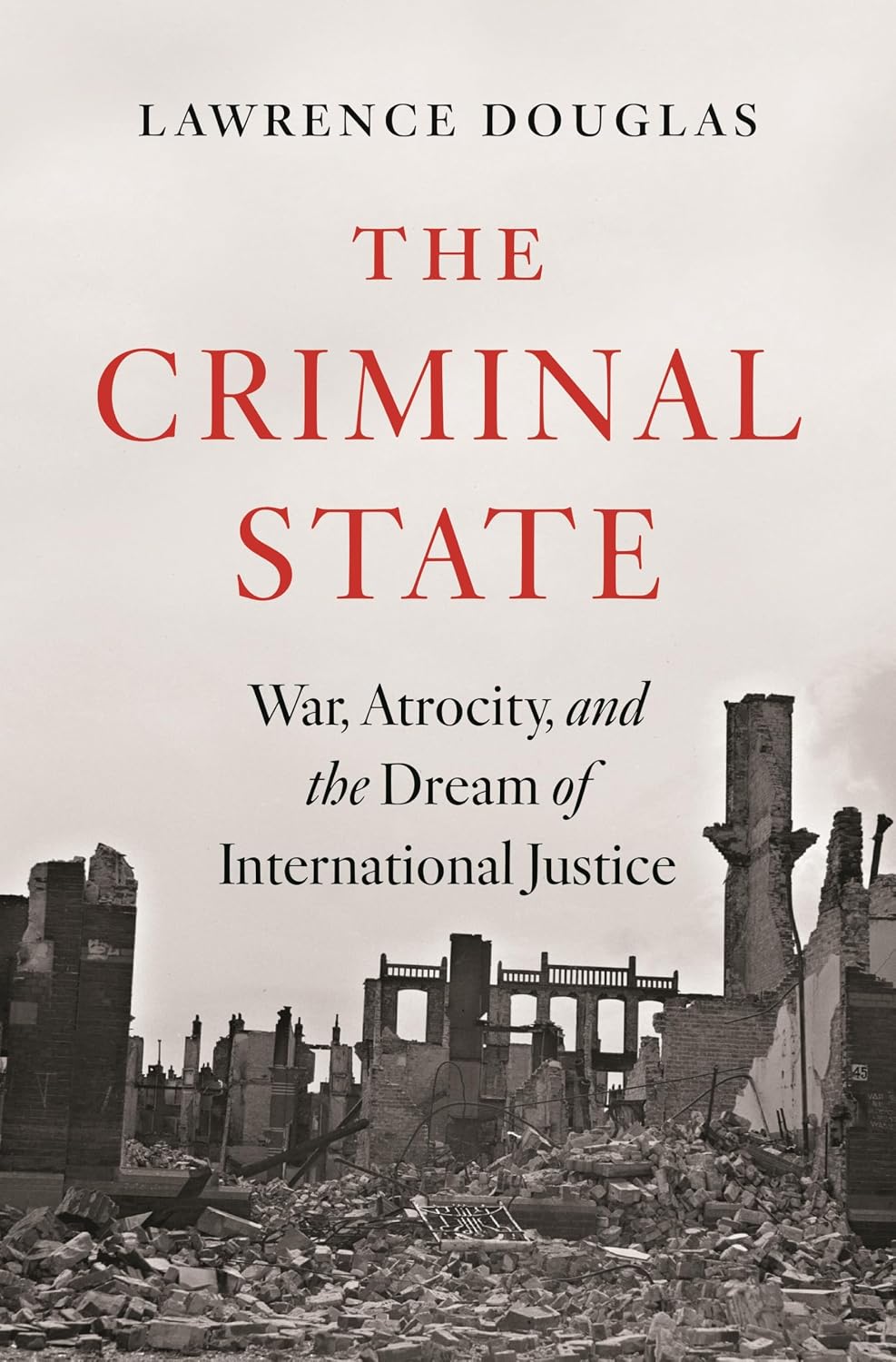
The Criminal State: War, Atrocity, and the Dream of International Justice
Douglas, Lawrence
Reviewed by Kirkus Reviews on February 16, 2026
A lucid investigation of a complex area of international law and the political order.

.svg)
A lucid investigation of a complex area of international law and the political order.
Comprehensive history of the evolution of laws criminalizing state violence.
Amherst College law professor Douglas opens his account with a moment in West German legal history that would have applied the statute of limitations to Germans who committed war crimes in the years of the Hitler regime. The philosopher Karl Jaspers rejoined that the entire Nazi government constituted a Verbrecherstaat, “a criminal state, not a state that happened to commit crimes.” This was a novel doctrine: The Nuremberg trials charged individual Nazis with “crimes ‘against peace, war crimes, and ‘crimes against humanity.’” Formulating an entire government as criminal—the U.S. attorney who mapped out legal strategy at Nuremberg called the Nazi regime an “instrument of conspiracy and of coercion”—was controversial, but it has since informed international law. Douglas takes a leisurely tour of philosophers and legal theoreticians on both sides of the question; an early exemplar is Thomas Hobbes, who held that peace is an aberration and war is the natural state of human affairs, and the Nazi jurist Carl Schmitt is invoked as warning that calling warfare criminal imposes the risk of “turning war into a campaign of annihilation.” This in turn affords Douglas a refinement of legal doctrine: “Aggression is criminal only when it issues in atrocity.” The greatest at-large criminal in this regard is Vladimir Putin, whose war on Ukraine has involved countless atrocities—torturing prisoners of war, targeting civilians and particularly children, using rape and brigandage as instruments of terror. By this measure, Douglas writes, the use of discretionary, aggressive force becomes not a prerogative of the state but “the paradigmatic and most serious of international crimes.” Putin may rule over a Verbrecherstaat, but he is untroubled by what the rest of the world thinks or what international law demands—one more reason to hope for the end of his regime.
A lucid investigation of a complex area of international law and the political order.


.svg)