These D.P.s shared little besides having just lived through one of the most traumatic periods in modern history and finding themselves homeless in its wake. Housed in camps administered first by the United Nations and later by the International Refugee Organization, they would, over the course of the next five years, come to represent a collective bone in the craw of the former Allied powers, who themselves constituted no monolith, and whose motives for welcoming — or turning their backs on — particular populations among the refugees were mixed, to put it nicely.
One of the many virtues of “The Last Million” is the author’s ability to make vivid sense of a bewildering moment. He clarifies without oversimplifying. An emeritus professor of history at the CUNY Graduate Center and the biographer of Andrew Carnegie, William Randolph Hearst and Joseph Kennedy, Nasaw demonstrates throughout an especially supple sense of scale. Much of what makes the book so absorbing and ultimately wrenching is his capacity to maneuver with skill between the nitty-grittiest of diplomatic (and congressional, military, personal) details and the so-called Big Picture. In cinematic terms, he’s adroit at surveying a vast landscape with a soaring crane shot, then zooming in sharply for a close-up of a single face as it crumples.
The book takes shape as a story of insults heaped onto injury. Not only did much of the world look away from the horrors unfolding in the concentration camps as they transpired; when the time came to stand up and offer refuge to the tortured souls who had suffered those horrors, most countries did worse than nothing: They offered sanctuary to a whole rogues’ gallery of camp guards, quislings and murderers, no small number of whose left armpits bore the tattoo of the Waffen-SS — or scars that showed their clumsy attempts to cut away the bodily evidence of their war crimes.
How could such an egregious perversion of justice have come to pass? The answer is complicated, and it seems foolish to try to sum up in a sentence or two what Nasaw spends more than 600 pages charting so scrupulously. Suffice it to say that the fog of postwar allowed many collaborators to shed uniforms, destroy papers and slip quietly into D.P. camps. This was hardly a secret. As early as October 1945, in fact, this very newspaper printed an article that quoted a “reliable source” at United States military headquarters in Germany as saying that “at least one-third and probably more of the Balts” in the camps “are former members of the Saulis, a Baltic Fascist Organization. … Almost all of them prefer our enemy, Germany, to our ally, Russia.”
Later, the knotty domestic politics of multiple countries allowed this outrage to persist. So the need for cheap labor and “experienced” army personnel figured centrally in the determination of who would (or wouldn’t) receive immigration papers. Other factors included mounting Western hostility to the Soviet Union, the tired conflation of Jews with Communists and plain old-fashioned anti-Semitism. (Nasaw lets us eavesdrop on Gen. George Patton, no less, fulminating into his diary about those who “believe that the Displaced Person is a human being, which he is not, and this applies particularly to the Jews who are lower than animals.”) The focus on “utilitarian and political over humanitarian rationales for resettlement,” Nasaw writes, didn’t apply only to the situation at hand. It set the “harsh Darwinian” terms for how the “developed world” has dealt with subsequent refugee crises.
Among the longest festering of those crises is, of course, Palestine/Israel’s. Nasaw handles deftly the international aspects of this part of the story, in which the fate of that small, troubled piece of land became a ball kicked between England and the United States. This too was complicated. Harry Truman’s push for the open immigration of Jewish refugees to British-controlled Palestine and eventually for a Jewish state may have derived from his moral sense and lifelong reading of the Bible, though it involved other less lofty matters as well, including his need to secure the proverbial Jewish vote. America’s own immigration policies also played a role. Nasaw quotes the English foreign secretary Ernest Bevin as suggesting in 1946 that “regarding the agitation in the United States, and particularly New York, for 100,000 Jews to be put into Palestine,” he hoped “it will not be misunderstood in America if I say, with the purest of motives, that that was because they did not want too many of them in New York.” “Purity” seems not especially relevant to this conversation, but Bevin had a point. That said, his frank assessment of the situation got him into hot diplomatic water, whose temperature Nasaw does a typically astute job of gauging and putting in context.
The author’s account of the facts on the ground in Palestine/Israel produces the book’s only slight wobble — an uncharacteristic loss of perspective. It’s perhaps inevitable that if one views the violent history of the region so tightly through the lens of the desperate D.P.s, one will perceive the British Mandatory authorities’ strict post-1939 immigration quotas and refusal to simply “open the gates” as nothing but cruel and unusual. The quotas may indeed have been punishing, as Nasaw suggests, but they also derived from Britain’s (admittedly ruinous) attempts to referee an already 50-year-old struggle between two competing national movements whose origins had nothing whatsoever to do with Hitler.
Nasaw acknowledges, if very much in passing, the bitter irony of the fact that many of the Jewish D.P.s who stumbled at last onto Israel’s shores wound up occupying houses, villages and neighborhoods that had recently belonged to Palestinian Arabs, who themselves became refugees in 1948, denied the right to return to their homes. He tries hard to be “evenhanded.” But it’s perplexing that a writer as alert to political and rhetorical nuance as he is would use stock, boosterish terms like “nothing less than miraculous” to refer to the rapid resettlement of Jewish D.P.s in Israel, or employ the word “aliyah,” as though it were perfectly neutral. (It means “ascent” in Hebrew, and colors the notion of Jewish immigration to Israel with a definite ideological tint.)
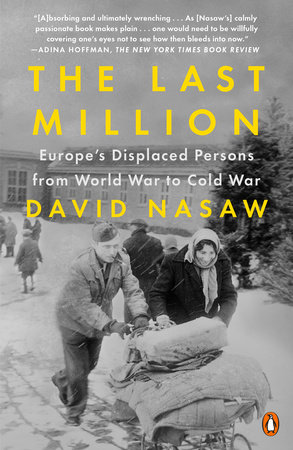
But these amount to very small quibbles, and “The Last Million” is greater than they are. Nasaw takes pains to avoid facile comparisons between the history he recounts and the current global moment, with its — our — own seas of refugees. As his calmly passionate book makes plain, however, one would need to be willfully covering one’s eyes not to see how then bleeds into now.

.svg)


.svg)